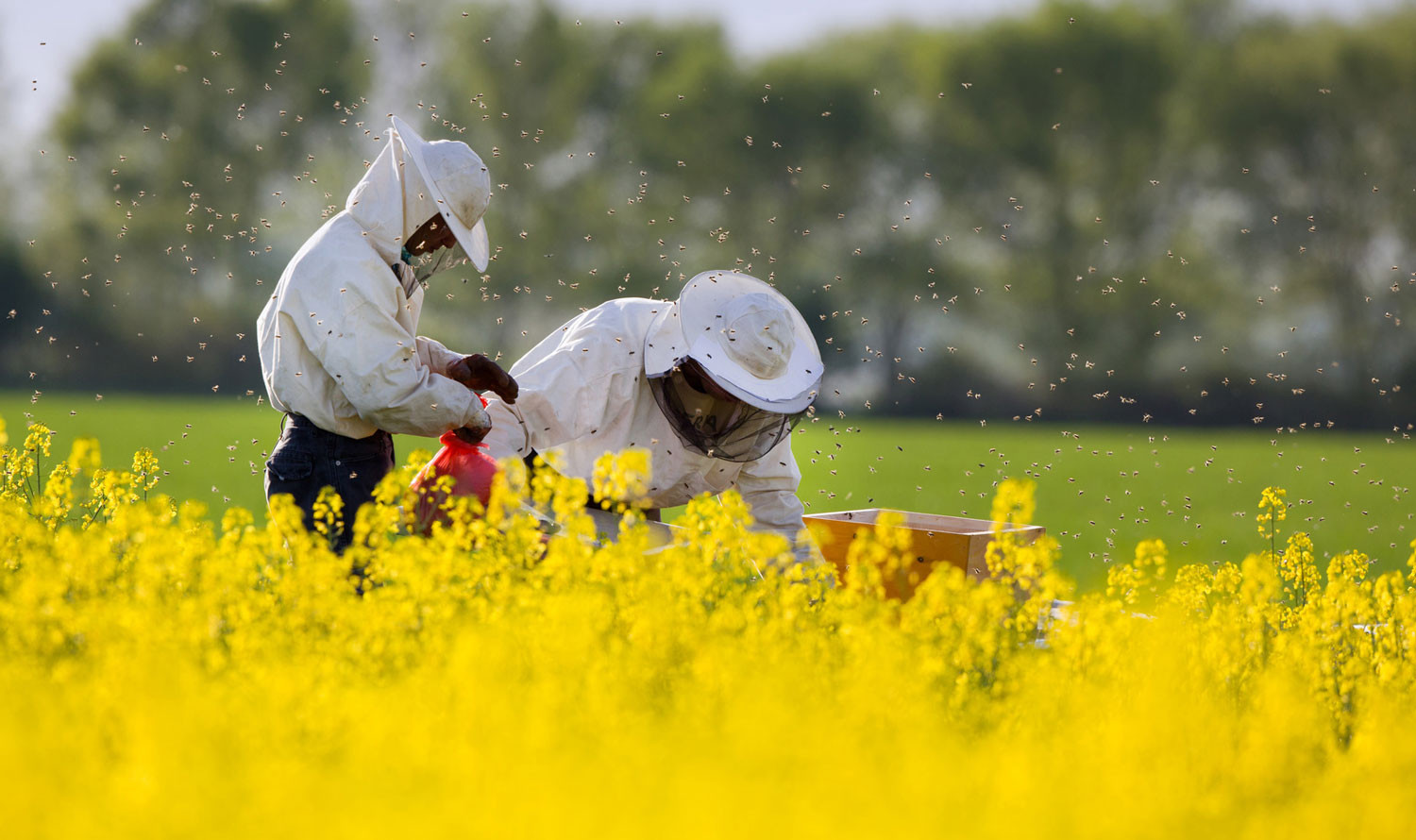


The Honey Harvest

From the honey super still on the hive to the sealed jar, every step of the harvest determines the quality of the final product. This article follows the complete process : assessing ripeness, extracting under the right conditions, managing crystallisation and filling correctly. Mistakes made early in the process cannot be corrected later — which is why every decision is explained together with its practical consequences. An article for beekeepers who want to understand why, not just how.
1. Harvesting at the right time
1.1 Why the timing of the harvest determines everything
 |
Objective |
The honey harvest is often experienced as the high point of the season. It is also the moment when hasty decisions — harvesting too early, mixing supers of uneven maturity, ignoring weather conditions — directly affect the quality of the final product and its long-term stability.
Honey is a natural product that is hygroscopic and sensitive to weather, temperature and storage conditions. Once extracted, it does not continue the biological maturation that takes place in the colony. Fermentation depends in particular on water activity, which is itself related to water content, honey composition and the presence of yeasts. A high water content therefore increases the risk of fermentation, but does not by itself determine whether the honey will remain stable.
But honey quality does not depend solely on the right harvest timing. It also depends on a strict separation between what belongs to the honey circuit, the brood circuit and the feeding circuit. Super frames, brood frames or food frames that are not clearly distinguished can compromise the product's compliance, traceability and quality, even if the honey is ripe and properly extracted.
This article follows the beekeeper from the super still on the hive all the way to the closed jar, ready to be sold or given away.
1.2 Recognising ripeness: three tools, a single objective
 |
Objective Capping, the shake test and the refractometer are not equivalent. They provide complementary information. The refractometer estimates water content from the refractive index and provides the most useful practical measurement for decision-making. |
Capping is the first signal. A high proportion of capped cells — often two-thirds or more in practice — generally indicates honey that is further advanced in its maturation. But this is not an absolute guarantee: during a strong nectar flow, bees may cap honey that is still too moist if the intake is very rapid. Capping is therefore a first decision filter, to be complemented by measurement when water content is uncertain.
The shake test is a quick check on an uncapped frame. Hold the frame horizontally and give it a sharp downward movement. If droplets come out, the honey is still too fluid and should be checked before any harvest. If nothing runs out, this indicates a thicker consistency, but it does not by itself guarantee compliant water content.
The refractometer estimates water content from the refractive index and is the practical reference tool. It must be correctly calibrated, and the measurement must be representative of the batch: take samples from several frames of the same super, not only from the nicest-looking ones. A single measurement on a single frame does not necessarily represent the whole super.
Important: a frame may appear "harvestable" from a water-content perspective but still not be admissible for the table-honey circuit if there is confusion with the brood circuit or the feeding circuit. Ripeness therefore does not replace the requirement to keep frames separated.
1.3 The three water-content thresholds: do not confuse them
 |
Objective Three values circulate in the beekeeping literature. They do not answer the same question and do not apply in the same situations. |
| Level | Value | What it means |
|---|---|---|
| Legal limit (Switzerland, ordinary honey) | 20 % | Above this level, the honey cannot be placed on the market. It is a line not to cross, not a target to reach. |
| Label standard (Apisuisse) | 18.5 % maximum | Requirement of quality programmes with a label. It provides a greater preservation margin, but is not by itself a general guarantee of stability or safety. |
| Quality target (Agroscope / practice) | < 17.5 % | Recommended quality target, providing a greater margin against fermentation risk under normal storage conditions. |
Practical point: aiming at 20 % as a harvest target is a common mistake. The legal limit is a line not to cross. In practice, harvesting with a target of below 18 % leaves a useful margin, not least because honey can absorb ambient moisture during extraction and storage. Water content nevertheless remains a practical indicator: stability also depends on composition, yeast load and storage conditions.
1.4 Weather window and ambient humidity
 |
Objective Honey that is well ripened in the hive can see its water content rise at harvest if conditions are unfavourable. This risk is often underestimated. |
Honey is hygroscopic: exposed to moist air, it absorbs water. Open frames in an environment with high relative humidity — while removing supers, during transport, or in an uncontrolled extraction room — can see their water content rise measurably.
A few practical benchmarks:
- Avoid harvesting during or just after a prolonged period of rain.
- Do not leave extracted frames exposed to open air longer than necessary.
- Work in an extraction room that is as dry as possible: relative humidity in the order of 50–60 % can serve as a practical benchmark, without constituting a universal boundary.
- Close supers and containers as soon as possible.
The time of day can also matter: depending on the local climate, late morning on a dry, sunny day often corresponds to a lower relative humidity than early morning or evening. This benchmark does not replace observation of the actual conditions.
1.5 Clearing the bees from the supers: three methods
 |
Objective No method is universally superior. The right choice depends on the number of colonies, the available time, the weather and the activity of the bees. |
| Method | Advantages | Points to watch |
|---|---|---|
| Clearer board (placed the day before) |
Little stress for the bees. Super almost empty the next day. Minimal direct handling. | Requires two visits to the apiary. In humid weather, or if the supers stay long outside the hive's microclimate, the frames may pick up moisture from the ambient air. Remove as soon as possible: the duration depends on the conditions and is not a universal deadline. |
| Brushing off or shaking frame by frame | Very selective: allows harvesting only the ripe frames. A single visit is enough. | More handling, more disturbance. Greater risk of robbing if frames remain exposed. Requires experience and speed. |
| Blower | Fast on large operations. Effective. | Additional equipment. More disturbance at the apiary. Less suited to small operations or apiaries close to dwellings. |
Additional point of vigilance: when removing frames, avoid any confusion between super frames, brood frames and food frames. A super destined for harvest must stay within a clean, distinct and clearly identifiable circuit. Only brood-free super frames intended for the honey circuit are harvested and extracted.
In all cases: cover removed supers without delay, avoid leaving frames in the open air and manage the risk of robbing, especially during dearth.
1.6 Transport and temporary storage of supers
 |
Objective Between the moment the super leaves the hive and the moment the frames enter the extractor, several classic mistakes can compromise an otherwise well-ripened honey. |
Common mistakes to avoid:
- Leaving supers exposed to the sun in a closed vehicle: the wax of the frames can soften and the honey ages more quickly with heat.
- Storing supers in a damp room or close to strong-smelling products: honey absorbs odours and moisture.
- Waiting several days before extracting: the longer the wait under uncontrolled conditions, the greater the risks.
- Stacking open supers without a lid: a direct invitation to robbing and to moisture pick-up.
- Transporting or storing super frames together with brood frames or food frames: this blurs the separation of uses and increases the risk of misallocation, soiling or contamination.
- Using the same trays, boxes, crown boards or transport surfaces for frames intended for honey and then for frames from the brood circuit without cleaning in between.
Practical rule: extract the frames quickly, preferably on the day of the harvest or as soon as the conditions in the extraction room allow, in a clean, dry, closed room. Frames still warm from the hive are easier to process: the honey is more fluid, which facilitates extraction and filtering.
1.6.1 Strictly separate the honey circuit from the brood circuit
 |
Objective Honey can be harvested at the right time, with a good water content, and still be problematic if the circuits are not kept rigorously separate. |
Basic principle. The honey circuit must remain distinct from the brood circuit and the feeding circuit. In practice this means that only super frames without brood are harvested and extracted, and that any confusion as to their destination is avoided during handling, transport, temporary storage and extraction.
Frames that have contained brood. A super or frame that has contained brood should not be returned indiscriminately to the table-honey circuit. Once a frame has changed use, it must be identified as such and handled according to the logic of the wax circuit or the brood circuit, not as an ordinary harvest frame.
Feeding. Honey destined for harvest must not be exposed to any risk of transfer of feeding sugar. There is no universal waiting period that alone guarantees the absence of transfer. The most robust rule is to separate feeding and honey production in time and space, control the periods and quantities distributed, and document the end of feeding before replacing supers intended for honey.
Practical organisation. Simple cues prevent many mistakes: distinct marking of supers and trays, separate storage zones, a clear order of work in the extraction room, and cleaning of tools or surfaces whenever they have been used for frames from another circuit.
1.7 Special cases according to honey type
 |
Objective |
Rapeseed (Brassica napus)
Rapeseed honey crystallises very rapidly — sometimes within a few days after harvest — and can start to crystallise in the cells even before being extracted. It is essential to harvest as soon as the honey is ripe, without waiting. Any delay risks making extraction difficult or even impossible on some frames.
Forest honeys and honeydew
Forest and honeydew honeys often have a higher mineral content, but their viscosity and behaviour vary according to composition. Some honeydew honeys contain a high proportion of melezitose, a sugar that crystallises rapidly and can block the cells. Close monitoring and rapid extraction are then necessary. Not all honeydew honeys are rich in melezitose, however: observe the individual batch rather than generalising.
Spring honeys (dandelion, fruit trees)
These honeys often have a high glucose content and a rapid crystallisation comparable to rapeseed. Monitor ripeness closely and do not leave the frames on the hive beyond what is necessary once the flow has ended.
1.8 Summary — Harvesting at the right time
The harvest is a decision, not a date. It is made on the basis of concrete observations, under good weather conditions and with the right tools. Mistakes made here cannot be corrected downstream.
| Control point | What to check |
|---|---|
| Frame ripeness | High proportion of capped cells, shake test as a screening check, followed by a representative refractometer measurement if necessary |
| Target water content | Practical target < 18 %; 20 % is a legal limit, not a goal |
| Weather conditions | Dry weather, low ambient humidity, avoid after a long rainy period |
| Method for clearing the bees from the supers |
Adapted to the situation; supers covered without delay |
| Separation of frames and circuits | Harvest and extract only super frames without brood; do not mix super frames, brood frames and food frames |
| Transport and storage | No excessive heat, no exposure to moist air, extract quickly |
| Honey type | Rapeseed, some spring honeys and honeydew honeys rich in melezitose require close monitoring and extraction without unnecessary delay |
2. Extracting and controlling quality
2.1 Preparing the extraction room: hygiene, materials, temperature
 |
Objective The extraction room does not need to be a laboratory. But it must meet a few basic requirements that directly determine food safety and the sensory quality of the product. |
Bee-tight. The room must be closed to bees throughout the entire work. An open window or an ajar door is enough to trigger robbing that is hard to control — and to introduce unwanted contaminants.
Surfaces and materials. Only food-grade materials are admissible in contact with honey: stainless steel, glass, certified food-grade plastic. Unprotected metals (zinc, copper, iron) react with the acidity of honey and can alter its colour, taste and composition. Cracked or scratched containers are difficult to clean properly and should be replaced.
Cleanliness and drinking water. All equipment must be clean and dry before use. Cleaning is done with drinking water. Residual moisture in a poorly dried container is a direct risk for the honey's water content.
Ambient temperature. An extraction room at 20–25 °C is a common working range that facilitates extraction, filtration and decantation. Below 18 °C, viscosity generally rises and these operations slow down. These are technical benchmarks, not universal quality thresholds.
Odour neutrality. Honey absorbs odours. An extraction room that smells of diesel, household products, paint or pets is a problem room. Air out in advance, then close before starting work.
Separation of circuits. The extraction room must also be thought of as an organised space. Supers and frames destined for honey should not indiscriminately share the same zones, trays, tools or work surfaces as material from the brood or feeding circuit. When material separation is not possible, a strict order of work and intermediate cleaning become mandatory.
2.2 Uncapping: methods and wax management
 |
Objective Uncapping is the first technical step of extraction. Careful work reduces the load on the filters, limits honey losses and preserves wax quality. |
The tools. The uncapping knife — whether cold, heated in hot water or electrically — remains the reference for clean work on regular frames. The uncapping fork is useful for irregular or slightly sunken areas. The key is to cut as shallowly as possible: the objective is to open the cells, not to remove a layer of comb.
Common mistakes. Cutting too deeply brings wax fragments into the honey and weakens the comb for the following seasons. Working with a cold tool on viscous honey tears the wax off rather than cutting it. A slightly warmed knife — not burning hot — glides better and causes less damage.
Cappings wax. It is generally of high quality — light-coloured and less burdened with residues than older waxes — and represents a valuable raw material. It should not be discarded or indiscriminately mixed with old wax. Letting it drain in an appropriate tray allows the residual honey to be recovered before the wax is processed separately. This drained honey can be added to the batch if its water content and origin are controlled, or set aside for a different use.
Additional point of attention. Uncapping does not correct a sorting error. Frames from the wrong circuit do not become admissible for table honey simply because they have been neatly uncapped. The sorting of supers and frames must therefore be done upstream, before entering the extraction room.
2.3 Extracting: managing the centrifugation
 |
Objective |
Tangential or radial extractor? In a tangential extractor, frames are placed perpendicular to the axis of rotation. One face is extracted, then the frames are turned to extract the other. In a radial extractor, frames are arranged like the spokes of a wheel and both faces are extracted simultaneously. The radial is faster for large quantities; the tangential is often more accessible for small operations and works well with frames of various sizes.
Controlling the speed. Whatever the machine, the rule is the same: ramp up the speed progressively. A sudden start on loaded frames causes imbalances and can break the combs, especially on thin foundation or partially crystallised honey. For a tangential extractor, a first pass at moderate speed on the exposed face, before turning and extracting completely, prevents the weight of the other face from deforming the comb.
Temperature and fluidity. Frames still warm from the hive extract much more easily than frames that have cooled down. If the supers have been stored overnight, moderate warming — for example to around 25–30 °C — can improve the yield. The important rule is to limit the thermal load: the effect on enzymes, HMF, colour and aromas depends on the combination of temperature and duration. There is no single threshold — neither 35 nor 40 °C — below which any alteration would be impossible and above which it would be automatic. Avoid any unnecessary, prolonged or repeated heating.
Swiss legal framework. Honey must be processed without overheating. If honey has been overheated, its designation and the statement "intended exclusively for cooking" must comply with the requirements applicable to baker's honey or industrial honey. If in doubt, keep the batch separate and check its intended use before sale.
Balancing the load. A poorly loaded extractor vibrates, wears out prematurely and can damage the frames. Always load symmetrically — even number of frames, equivalent weight on both sides.
Batch traceability. When several supers or lots are extracted on the same day, keeping a clear separation logic remains important: do not, for convenience, mix clean and well-identified supers with material of uncertain origin or from another circuit.
2.4 Filtering and decanting
 |
Objective Filtering does not mean sterilising. An appropriately coarse or fine filtration removes debris introduced by the process while generally retaining a large part of the pollen. Very fine filtration can remove a substantial proportion of the pollen and make interpretation of botanical or geographical origin more difficult. |
Mesh size. In the Swiss framework, the sieve must leave the pollen in the honey. A minimum mesh size of 0.2 mm (200 µm) is used as a regulatory or quality-programme benchmark: below this, some pollen may be retained. In practice, a double honey strainer (coarse mesh + fine mesh, both at least 0.2 mm) placed directly under the extractor is generally sufficient for clean work. The requirements of the sales channel or the relevant label remain decisive.
Do not force filtration. Pressing the honey through a saturated filter to speed things up introduces air bubbles and can mechanically fracture wax particles. It is better to change or rinse the filter regularly during the work.
Decanting in a settling tank. After filtration, the honey usually rests 24 to 48 hours in a settling tank — a flat-bottomed vessel with a bottom tap. During this time, air bubbles and the last light particles rise to the surface as a foam. This foam must be completely removed before bottling. Cover the settling tank for the entire decantation period: an open honey absorbs ambient moisture and odours.
Decanting temperature. Around 20–25 °C, decantation is generally effective. Below 18 °C, the honey becomes more viscous and particles rise more slowly. A higher temperature can accelerate separation, but prolonged exposure increases the thermal load: choose the shortest duration compatible with the desired result.
Keep in mind. Filtration does not correct contamination linked to a poor choice of frames or to a confusion between circuits. It removes coarse debris; it does not "purify" a lot that was poorly composed to begin with.
2.5 Checking water content after extraction
 |
Objective The post-extraction measurement covers the entire batch, not an isolated frame, and determines the rest of the process. |
Measuring correctly. Take samples at several points in the settling tank (surface, middle, bottom) and homogenise them before measuring. The refractometer must be calibrated and the measurement taken at 20 °C or corrected according to the table supplied with the instrument.
Interpreting the result.
These thresholds guide decision-making: they do not turn a water-content measurement into an absolute guarantee of stability. Honey composition, yeast load, crystallisation and storage conditions must also be taken into account.
| Measured water content | Recommended decision |
|---|---|
| < 17.5 % | Quality target achieved. Continue as usual while maintaining good hygiene and storage conditions. |
| 17.5–18.5 % | Good. Store with care, bottle rapidly, avoid any additional moisture input. |
| > 18.5 % to 20 % | Within the legal limit, but outside the 18.5 % label requirement. Keep separate, do not mix with other batches and monitor its evolution. |
| > 20 % | Do not market as honey. Keep the batch separate and check possible uses or processing options in accordance with the applicable requirements. |
Never mix a borderline batch with a dry batch to improve the average. This dilutes the risk without eliminating it.
Likewise, do not mix for the sake of convenience a clean and well-identified batch with a batch whose origin, circuit or previous frame use is uncertain. The quality of a lot cannot be recovered by dilution or averaging.
|
⚠ Post-harvest moisture reduction: a last resort It is technically possible to reduce the water content of an overly moist honey after extraction, for example in a controlled, dehumidified installation. This approach may help in an exceptional situation, but it exposes the honey to air, odours and possible thermal load. It must not become routine, for two important reasons. First, it does not correct the cause of the problem — honey harvested too early. Second, bringing a batch back into compliance through moisture reduction or another intervention, as well as the relevant quality programmes, may be regulated: check the intended use and the applicable requirements before using it for honey destined for sale. The only reliable solution remains harvesting at maturity. |
2.6 Summary — Extraction and quality control
Extraction is a chain. Each step determines the next. A problem detected too late — water content too high, odour contamination, insufficient filtration — is difficult or impossible to correct without degrading the product.
| Step | Critical control point |
|---|---|
| Extraction room | Clean, dry, bee-tight, odour-neutral, food-grade materials |
| Separation of circuits | No confusion between honey, brood and feeding circuits; clean tools and surfaces |
| Uncapping | Cut shallowly, collect cappings wax separately |
| Centrifugation | Progressive speed ramp-up, limit thermal load, avoid prolonged or repeated heating |
| Filtration | Appropriate strainer, preserve pollen, do not force filtration, change the filter when saturated |
| Decantation | Generally 24–48 h covered, 20–25 °C, skim fully before bottling |
| Water content measurement | Calibrated refractometer, homogeneous sample, decision per batch |
3. Bottling, labelling and storage
3.1 Crystallisation: understanding to master it
 |
Objective Crystallisation is not a defect and, by itself, is not a sign of quality deterioration. It is a natural process that depends on the composition and temperature of the honey. An uncontrolled texture can nevertheless complicate extraction, bottling or the use expected by customers. |
Honey is a supersaturated sugar solution. Crystallisation occurs when glucose molecules separate from water and organise into crystals. Its speed depends on three main factors:
Sugar composition. A glucose-rich honey (rapeseed, dandelion, spring) crystallises rapidly — sometimes in a few days. A honey with a high proportion of fructose, such as some acacia honeys, stays liquid much longer. Forest and honeydew honeys are variable and should not be reduced to a single rule. The glucose/fructose ratio depends mainly on origin and cannot simply be changed after harvest.
Temperature. Crystallisation is generally favoured in a range of about 10–18 °C and is often particularly rapid around 14 °C. At higher temperatures it slows down, while very low temperatures slow it considerably without necessarily stopping it. Keeping reliquefied honey in the refrigerator is therefore not a lasting solution: the process can resume as soon as the temperature rises.
Crystallisation nuclei. Particles already present and crystals that have already formed can provide nucleation points. A large number of fine crystals generally favours finer and more homogeneous crystallisation. This principle is used in creamed honey production, but the result also depends on the composition and handling of the batch.
| Type of honey | Crystallisation speed | Practical consequence |
|---|---|---|
| Rapeseed, dandelion, spring | Very fast (days) | Bottle rapidly or manage creaming without delay |
| Summer flowers, lime, clover | Moderate (weeks) | Comfortable working window |
| Acacia, some forest or honeydew honeys | Slow (months) | Can remain liquid for a long time, depending on composition and storage |
| Melezitose (some honeydew honeys) | Very fast and compact | Close monitoring, very rapid extraction essential |
3.2 Managing crystallisation: liquid, creamed or natural
 |
Objective The final texture of the honey is a decision, not an accident. It must be made early, because the action windows are narrow for some honeys. |
Liquid honey. Bottle rapidly after decantation, before crystallisation progresses. This presentation suits honeys whose composition favours slow crystallisation, for example some acacia honeys. Forest and honeydew honeys are more variable. For rapidly crystallising honeys, the honey may become solid in the customer's jar: it is useful to inform the customer clearly.
Creamed honey. This is a commonly used technique for directing the texture of rapidly crystallising honeys. It consists of seeding the still-fluid honey with a suitable quantity of quality creamed honey (seed honey with very fine crystals), often in the order of 5–10 %, and then stirring it regularly within a temperature range favourable to crystallisation. The proportion, stirring frequency and temperature do not form a universal protocol: they must be adapted to the type of honey and the equipment. The honey is bottled when it reaches the desired consistency — neither too liquid nor too firm.
The robust principle is to create and distribute many fine crystals while avoiding the incorporation of air and unnecessary heating of the batch. The steps below describe one practical method among several.
|
Producing creamed honey: the key steps
|
Natural crystallisation. Some honeys can be left to crystallise freely, without intervention. The texture is then less predictable, but crystallisation is not in itself a sign of quality deterioration. This approach suits personal use or a customer base that values the natural character, provided the absence of fermentation is monitored.
What not to do: heat an already crystallised honey regularly or for a long time to make it liquid again. Prolonged or repeated thermal exposure can reduce enzyme activity, promote HMF formation and alter colour, aromas and other characteristics. There is no magic threshold of 40 °C: the effect depends on the combination of temperature and duration. If reliquefaction is necessary, proceed gradually, in a controlled manner and for as short a time as possible, for example in a bain-marie or suitable installation, never in a microwave.
3.3 Bottling
 |
Objective |
Containers. Glass preferably — neutral, impermeable, reusable and inert. Food-grade plastic is admissible but must be certified for contact with foodstuffs. Lids must seal hermetically.
Dry jars. Clean the jars with drinking water and let them dry completely before use. Steam treatment can be included in the hygiene plan, but it does not replace drying. A drop of water at the bottom of a jar represents a localised moisture input and should be avoided.
Timing according to target texture. For liquid honey, fill as soon as decantation is complete. For creamed honey, fill when the texture is reached but still soft. A honey that has already firmed up in the settling tank is very difficult to transfer without incorporating air.
Temperature of jars and honey. A large temperature difference between honey and jar causes condensation inside. Let the jars acclimatise to room temperature before filling them.
Close promptly. The longer a filled jar remains open, the greater the risk of absorbing moisture and odours. Close the lids without delay and check the seal.
Order and cleanliness. Bottling must remain the last step of a clean circuit. Avoid storing jars, lids or bottling utensils in damp, dusty places or places exposed to foreign odours.
3.4 Labelling
 |
Objective |
|
Mandatory statements on each jar sold (Swiss food law)
To be avoided: misleading statements ("100 % natural", "pure"), unauthorised health claims, varietal designations without sufficient basis. → For details and particular cases: consult the Apisuisse practical guide "Labelling honey correctly" and the dedicated ApiSavoir article. Statements about floral or botanical origin, geographical origin, quality or inspection must not mislead the buyer. |
3.5 Storage
 |
Objective |
Basic conditions. Honey is kept in a cool place (in practice, around 10–16 °C), dry, protected from light and hermetically closed. These conditions are not difficult to meet — but they are often neglected. This is not an absolute threshold for every batch, but a storage compromise that slows undesirable changes.
Light and heat. Exposure to light and high temperatures can accelerate aroma loss, colour changes and HMF formation. The effect depends on the cumulative duration and temperature; transparent jars placed in a sunny display are particularly exposed.
Moisture. A jar that is not sufficiently airtight can let moisture in, especially in a damp room. Hobbocks must be stored lid-up, checked regularly and kept in a dry place.
Stock rotation. Apply the "first in, first out" principle. Older honeys must leave before new harvests. Persistent bubbles, a sour smell or taste and a bulging lid may indicate fermentation: isolate the batch and do not sell it until its compliance has been clarified.
Large containers. Hobbocks must be hermetic, in food-grade material, labelled with lot number and harvest date. Never top up a new-harvest honey into a hobbock already opened from a previous season.
Also avoid slow contaminations. Even when well closed, a poorly managed stock can be problematic if the containers are kept close to odorous substances, paints, fuels, household products or other sources of foreign odours.
3.6 Traceability and minimum documentation
 |
Objective |
Traceability does not require a complex system. For a small-scale beekeeper, a simple register is enough, provided it makes it possible to link each jar sold to a precise batch. The documents to retain and the retention period may depend on the sales channel: check the applicable requirements, especially when honey is supplied to intermediaries.
The useful minimum per batch:
- Harvest date and apiary of origin
- Type of honey (blossom, forest, rapeseed…)
- Measured water content (value and date of measurement)
- Lot number (shown on the label)
- Quantity produced and packed
- Bottling date
- Destination or buyer, when required by the sales channel
- Useful observations on the harvest circuit in case of any particular event: recent feeding, change of use of certain frames, separation of risk batches, or any information useful to rule out any confusion between honey, brood and feeding
This register makes it possible, in the event of a complaint or a control, to immediately retrieve the information linked to a specific lot. It is also a useful personal tool for improving one's practice from one season to the next.
3.7 Overall summary — From super to jar
This article has followed the honey from the super still on the hive to the closed jar. The critical points can be summarised in the following principles:
| Principle | Why it is essential |
|---|---|
| Harvest only ripe honey | Water content at harvest is a key determinant of fermentation risk, conservation and quality |
| Strictly separate the honey circuit from the brood and feeding circuits | Honey quality is protected first of all by a clear separation of frames, supers, tools and batches |
| Work in a clean, dry extraction room | Hygiene and control of ambient humidity protect the product at every stage |
| Limit the thermal load | Effects on enzymes, HMF, colour and aromas depend on the ratio of temperature to duration; avoid unnecessary, prolonged or repeated heating |
| Filter without removing pollen | Remove visible debris with an appropriate strainer, without confusing filtration with sterilisation or using filtration to correct a poor batch |
| Measure and decide per batch | A representative water-content measurement helps assess fermentation risk, but must be interpreted together with composition and storage |
| Store cool, dry, dark and hermetically sealed | Reduce the absorption of moisture and odours as well as changes linked to time and temperature |
| Label and trace every batch | Link the jar and batch to their origin, measurement, bottling date and destination so action can be taken if a problem arises |
See also:
- Mastering the water content of honey
- Refractometer calibration
- Honey crystallisation
- Honey labelling
- Optimising good beekeeping practices for honey production
- Best practices in beekeeping (meta-study)
- All about honey