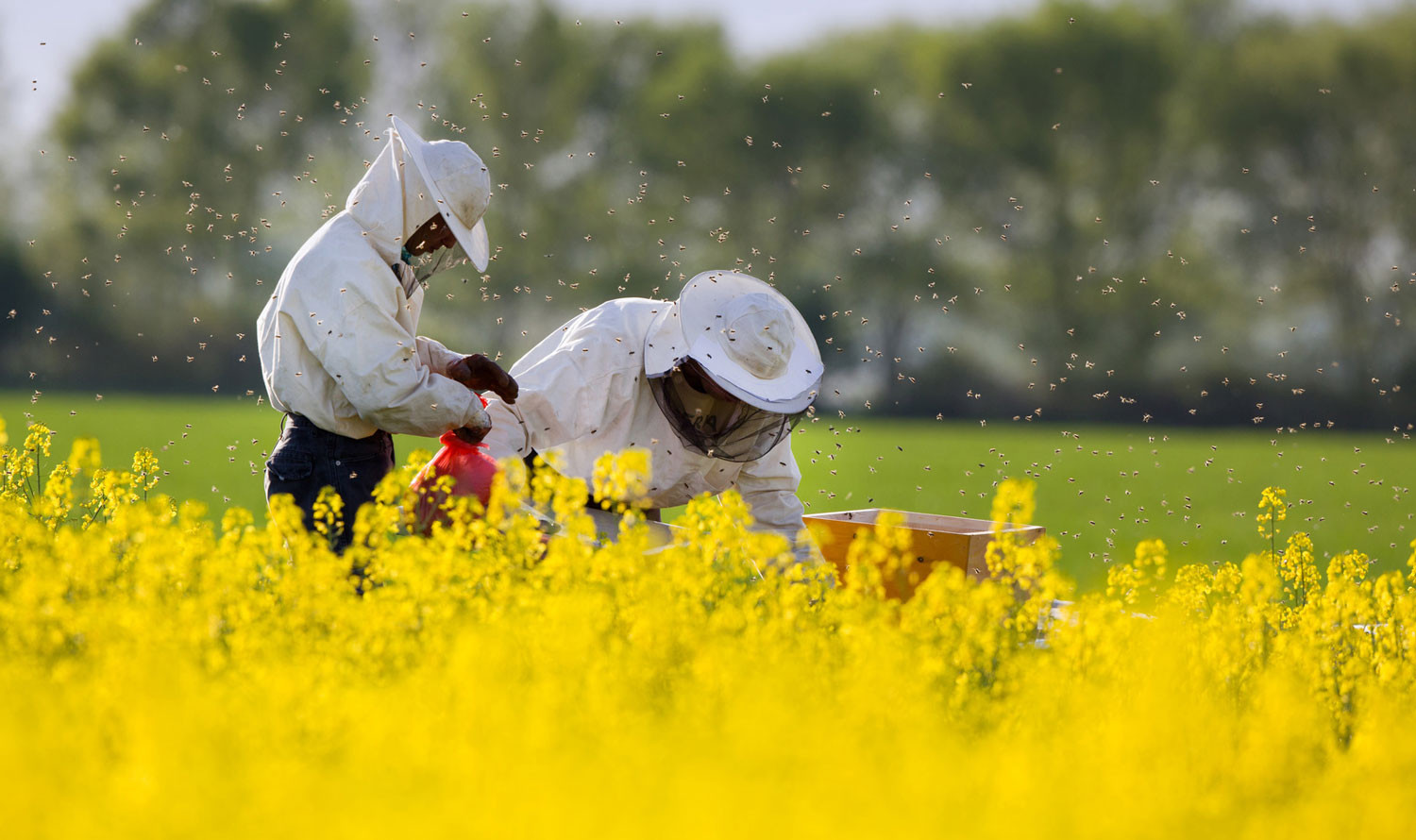


Honey bees are staggering near damaged fruit and struggling to take off. Which statements are correct?
More than one answer is correct.
- These signs are sufficient to diagnose ethanol poisoning.
- Experiments show that ethanol can impair motor behaviour and certain learning abilities in honey bees.
- The amount of ethanol in the crop necessarily equals the dose already absorbed into the body.
- Diseases, pesticides, cold or an energy deficit can cause similar signs.
- An alcohol-containing bait reliably prevents honey bees from consuming it.
- The food source visited, the timing and the extent of the disturbance should be documented. If many bees are affected, episodes recur or the colony weakens, the relevant bee health services should be contacted.
Show answer
Correct answers: 2, 4 and 6.
Why?
- 1 — False. Staggering and difficulty flying are non-specific signs. Proximity to damaged fruit proves neither ethanol ingestion nor its role in the observed disturbance.
- 2 — True. Experiments with Apis mellifera show effects on motor behaviour and certain learning performances. These depend on factors including dose, exposure duration and the endpoint measured; they do not establish a universal intoxication threshold.
- 3 — False. The crop holds food being transported. Its contents alone do not reveal how much ethanol has entered the tissues or haemolymph.
- 4 — True. These causes can produce similar signs and may act together. Chronic paralysis is one possible cause to consider. Excluding other causes alone does not confirm ethanol as the cause.
- 5 — False. Alcohol does not guarantee that a bait will be avoided. Honey bees can consume certain sugar solutions containing ethanol. Improvised traps may also harm non-target insects.
- 6 — True. Weather, the number of colonies affected and known treatments in the surrounding area should also be recorded. The relevant services determine the sampling and analyses needed.
What you need to understand
Attributing a disturbance to natural ethanol exposure requires a link between the food source actually visited, ingestion, internal exposure and the observed effect. Detecting alcohol in nectar or juice alone is insufficient.
Among the sources examined for the article, no identified study fully reconstructs this chain in honey bees under natural conditions. This does not prove that the phenomenon is absent; its frequency remains unknown.
Accepting an alcoholic sugar solution does not demonstrate a specific attraction to pure ethanol. In practice, avoiding fermented feeding syrup and keeping feeders clean helps prevent unnecessary exposure.
Remember
A staggering bee presents a sign to investigate, not a diagnosis of drunkenness. Observation, documentation and professional assessment of significant episodes help identify the cause without premature conclusions.